Why does knitted colorwork look squashed?
A circle drawn on a square grid can become a wide oval when you knit it. In stockinette, a stitch is usually wider than one row is tall, so equal numbers of stitches and rows do not make equal physical dimensions. The solution is to plan with both parts of your gauge. That lets you choose a chart whose knitted proportions suit the picture, rather than judging its shape only by the squares on screen.
A chart square is a position, not a measured square
In a simple colorwork chart, one cell usually tells you the color of one stitch in one worked row. It does not promise that this stitch occupies a square of fabric. If a motif is equally wide and high in cells, but the stitches are wider than the rows are tall, its knitted height will be smaller than its width. Circles, faces and lettering make the difference particularly easy to see.
This does not mean every chart printed with square cells is wrong. A designer may already have allowed for the fabric’s proportions in the stitch and row counts. Follow the chart’s instructions, including any return rows that are not drawn. Our guide to reading a knitting chart explains how cells relate to worked rows. Do not lengthen a tested pattern just because its drawing looks tall.
Measure the fabric you actually intend to knit
Use a washed, fully dried swatch in your project yarns, stitch pattern and technique. Count stitches across 10 cm (about 4 in), then rows over the same height. A single stitch is approximately 10 divided by the stitch count wide in centimeters; one row is approximately 10 divided by the row count high. Their width-to-height ratio is the row gauge divided by the stitch gauge.
There is no universal correction factor for all knitting. Garter stitch, stockinette and textured fabrics can have different proportions. Stranded knitting can also differ from a plain sample because the yarn carried behind the work affects the fabric. Match flat or circular construction too. The gauge swatch guide explains how to measure away from the edges and record both counts. Use your measured numbers, not just the yarn label.
A worked example: why 40 by 40 is not square
Suppose your gauge is 20 stitches and 30 rows per 10 cm (about 4 in). A chart with 40 stitches across and 40 worked rows measures 20 cm (about 8 in) wide but only about 13.3 cm (5.2 in) high. Its height is two thirds of its width. A circle drawn inside that square grid therefore becomes a flattened oval, even when you follow every cell correctly.
To fill a 20 × 20 cm (about 8 × 8 in) area at this gauge, you need 40 stitches and 60 rows. The chart has more rows than columns, although the knitted area is square. Redraw the motif over that taller grid, spreading its details through the extra rows. Merely adding blank rows above and below a 40-row motif changes the background height; it does not restore the motif’s proportions.
Choose the finished dimensions before the cell counts
For a new rectangular motif, calculate stitches = width in centimeters × stitches per 10 cm ÷ 10. Calculate worked rows = height in centimeters × rows per 10 cm ÷ 10. Round to whole stitches and rows, then check the resulting dimensions. Include uncharted return rows in the total height. Keep borders separate so you know how much of the available space belongs to the picture itself.
If the width is fixed, choose the height that preserves the picture’s width-to-height ratio, then calculate its row count. If both dimensions are fixed and the picture has a different shape, decide whether to crop it or leave background space. Forcing the whole picture into a differently shaped area distorts it. Reducing the number of colors can simplify a motif, but it does not correct a wrong stitch-to-row ratio.
Design on a grid that represents your gauge
Proportional knitting graph paper uses rectangles instead of squares. At the example gauge, each cell should be 1.5 times as wide as it is high. Draw the desired shape across those rectangles and count the cells for the knitting. The paper need not be actual size: the cell proportions are what matter. A digital preview using your gauge serves the same purpose, making the expected fabric shape visible.
If you redraw on an ordinary square grid instead, allow the charted motif to look taller than the intended fabric. Review curves, diagonal lines and letter spacing after adding rows; repeating arbitrary rows can produce lumpy outlines. Small motifs may need simpler details because a whole stitch is the smallest available unit here. The article on turning a photo into a knitting chart covers choosing and simplifying a picture before charting.
How the picture conversion preserves proportions
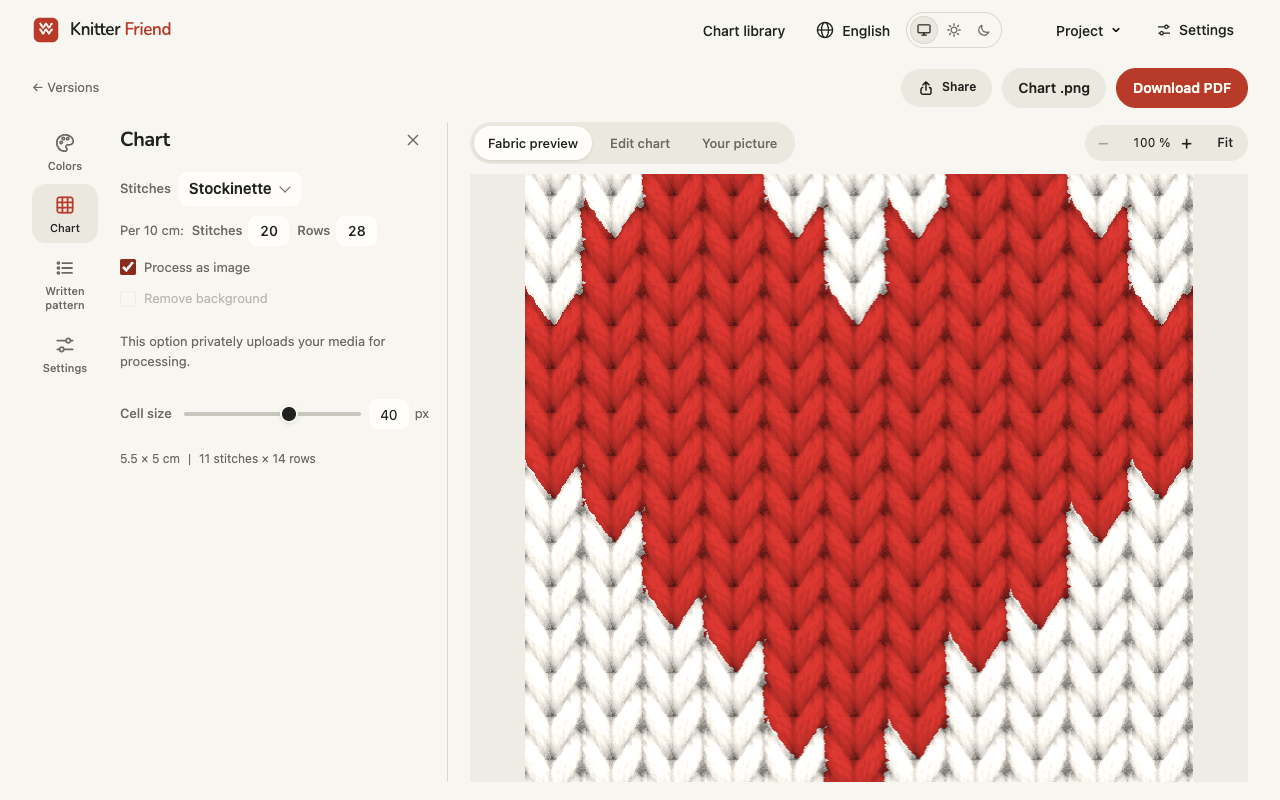
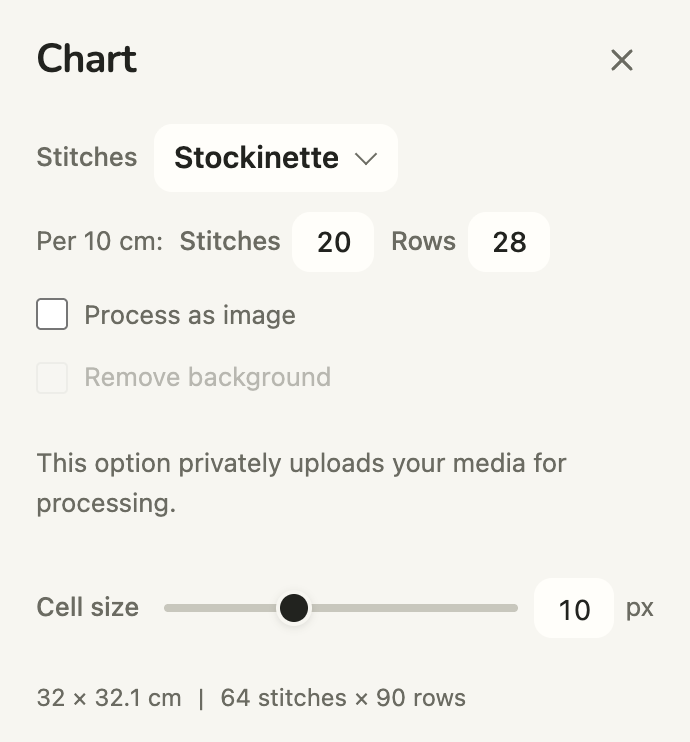
In Knitter Friend, enter your measured stitch and row gauge for the selected fabric. A picture chart is rebuilt from that gauge so that the knitted piece keeps the picture’s shape. The picture is cut into cells in the shape of a stitch, and each cell becomes one stitch: at the example gauge, a square picture charted 40 stitches wide gets 60 rows. Check the new counts and finished size, then open Fabric preview to see the fabric in your colors.
For an existing square-cell color chart that you want to treat as artwork, select Process as image. This changes its row count; it is not a way to preserve an existing pattern’s row instructions. Set size and gauge before correcting individual stitches. The picture-to-chart instructions explain the workflow. A preview remains an estimate until you knit the sample.
Open Fabric preview to compare the motif’s knitted proportions with the original drawing.
Check the motif, not only the outline of the swatch
Knit enough of the motif to assess its shape, then wash and dry it as planned. Compare its width and height with your calculation, and inspect the details as well as the outside dimensions. If the whole piece is a different size but the shape is right, check the absolute gauge. If the shape is wrong, check the ratio between stitch and row gauge and whether every worked row was counted.
Local puckering or tight bands can come from uneven tension or floats that pull the fabric inward; changing chart proportions does not fix those. Blocking may let the fabric settle, but stretching it aggressively is not a dependable substitute for planning the correct counts. Keep the sample and its measurements. If you change yarn, needles or technique, recheck gauge before relying on the same chart to give the same shape.